


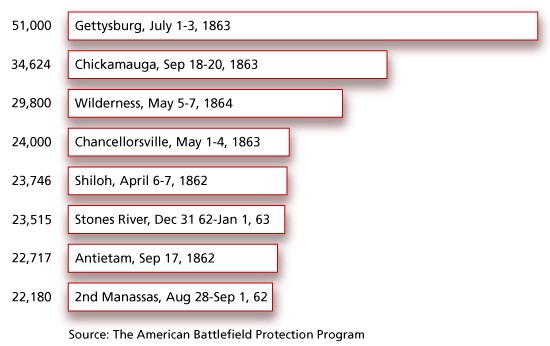
Antietam was the bloodiest one-day battle of the Civil War. But there were other battles, lasting more than one day, in which more men fell. The numbers below are total casualties for both sides.
The Battle of the Somme was one of the largest battles of World War I, and among the bloodiest in all of human history. A combination of a compact battlefield, destructive modern weaponry and several failures by British military leaders led to the unprecedented slaughter of wave after wave of young men.
The Battle Was Concentrated in a Small Area

“The German doctrine was that not a single yard of ground should be surrendered and the French and the British were determined to never stop the attack,” says Spencer Jones, senior lecturer in Armed Forces and War Studies at University of Wolverhampton.
“So both sides were locked into a frighteningly small area onto which an enormous amount of firepower was poured.”
On the first day alone the British endured more than 57,000 casualties. The nearly 20,000 British troops killed on day one of the infantry assault was so high it remains the single worst day in British military history. By the 141-day battle’s end, the Allies and Central powers suffered more than a million casualties combined.
The campaign, staged along an 18-mile stretch around the Somme River in France, was a joint French and British offensive to expel German forces. The location and timing of the attack was also intended to relieve pressure on Verdun, where French troops were enduring a punishing German attack.
British Artillery Shells Failed to Detonate
British General Sir Douglas Haig ordered a week-long artillery bombardment of more than a million shells starting on June 24. The hail of shells was intended to wipe out German barbed wire, front line trenches, artillery—and the morale of the German army.
“We were informed by all officers from the colonel downwards that after our tremendous artillery bombardment there would be very few Germans left to show fight,” recalled Lance Cpl. Sidney Appleyard of Queen Victoria’s Rifles.
In fact, more than half of the artillery shells failed to detonate, most of the German dugouts remained undamaged and their wire barricades remained largely intact.
The Germans Were Well Prepared
The terrain around the Somme was made up primarily of chalk, which the Germans had found well-suited for trench warfare, including a deep networks of fortified trenches, complete with rear supply fortifications and buried communication lines.
As British and French infantry went “over the top” of their trenches starting at 7:30 a.m., expecting little German resistance, they were mowed down by German artillery and machine gun fire. The advancing soldiers could not move quickly since most were carrying some 60 pounds of gear, including picks, sandbags and shovels to shore up enemy positions that they believed had been blown out by artillery and abandoned.
Allied Soldiers Were Easy Targets
Also exacerbating the slaughter was the fact that the advancing troops, in seeking out openings in the German barbed wire, ended up clustering at the gaps, making them easy targets.
One German machine gunner recalled, “When we started to fire we just had to load and reload…They went down in their hundreds. We didn’t have to aim, we just fired into them.”
Despite the shockingly heavy losses of July 1, General Haig and other military leaders resumed the attacks the next day – and the next. As Jones said, “There was a remarkable refusal to give up. That led to the battle’s overall horrifying death toll.”
Over the course of the campaign both sides fired artillery shells by the tons, unleash streams of machine gun fire, spray chemical weapons, fire flamethrowers, and British troops deployed tanks for the first time.
Casualties just kept rising as the Somme became a grueling battle of attrition. As Jones said, “Human flesh is powerless to withstand that amount of destruction.”
British commanders swiftly learned from their devastating showing in the early days of the battle and adjusted their tactics. In the end, the Allied forces advanced a mere six miles. But the devastating losses on both sides showed that any territory fought on the Western Front would be hard-won.
Battle of the Somme Was ‘a Ghastly Human Experience’
In the wake of the Somme’s and other battles’ grim death tolls, Germany eventually shifted its strategy away from the Western Front to initiate submarine warfare, which played a part in bringing the United States into the war.
The Battle of the Somme, says Gary Sheffield, Professor of War Studies at the University of Wolverhampton, “was a ghastly human experience,” but, he says, “it was not futile and it provided a stepping stone to victory in 1918.”
NIGERIA
Actors of Nigeria’s Civil War (1966-1970)
Segun Adewole
The Nigerian Civil War otherwise known as the Biafra War was fought from 1966 to 1970. It was between the forces of the Nigerian Government and the forces of Biafra which seceded from the country at that time.
As Nigeria celebrates the 2021 Armed Forces Remembrance Day, it is appropriate to take a brief look at the key actors in the civil war.
Here are eight of them:
1. Patrick Chukwuma Kaduna Nzeogwu
Nzeogwu was a young military officer who took part in the first military coup in Nigeria on January 15, 1966. He led a group of soldiers who killed Nigeria’s Prime Minister and the Premiers of the Northern and Western regions of the country. He died during the civil war.

2. Major General Johnson Thomas Umunnakwe Aguiyi-Ironsi
Aguiyi-Ironsi became the Head of State in Nigeria after the bloody coup of 1966 led by Nzeogwu. He was assassinated by a mutiny led by Northern military officers which included Major Murtala Mohammed, Captain Theophilus Danjuma, Lieutenant Muhammadu Buhari, Lieutenant Ibrahim Babangida, and Lieutenant Sani Abacha.

3. General Yakubu Gowon (retd.)
Gowon became the Head of States in Nigeria in 1966 after the counter-coup which led to the death of his predecessor Major General Aguiyi-Ironsi. He was the Head of State during the duration of the civil war and remained in power till 1975.

4. Chukwuemeka Odumegwu-Ojukwu
Ojukwu was the military governor of the defunct Eastern Region which broke away as The Republic of Biafra in 1966. He became the leader of Biafra which fought against Nigeria until it surrendered on January 15, 1970. He died in 2011 at the age of 78.

5. Brigadier Benjamin Adekunle
He was the General Officer Commanding 3 Armoured Division, Nigerian Army. He led the 7th and 8th battalion tasked to carry out a seaborne assault on Bonny in the Bight of Benin during the civil war. He died in September 2014.

6 General Murtala Mohammed
Murtala Mohammed was part of the Northern military officers who carried out the counter-coup that resulted in the death of the then Head of State, Major General Aguiyi-Ironsi. During the civil war, he was the Commander of the 2nd Infantry Division which pushed back Biafran forces from the Mid-Western Region. His Division then advanced into the Eastern Region through the River Niger after several failed attempts which resulted in casualties. He became the fourth Head of State in 1975 and was assassinated on Friday, February 13, 1976.

7. Victor Adebukunola Banjo
Banjo was a colonel in the Nigeria Army who fought on the side of Biafra after he was accused to have been part of the first coup in Nigeria. He was later executed on the orders of the Biafran leader, Ojukwu, on an allegation that he was plotting to overthrow him (Ojukwu).

8. Philip Effiong.
He was the Vice President and the second President of Biafra who announced the surrendering of the secessionists on January 15, 1970. He made that announcement in the presence of General Yakubu Gowon at the Dodan Barracks in Lagos.
