By Frank Adeche Time.i.NG
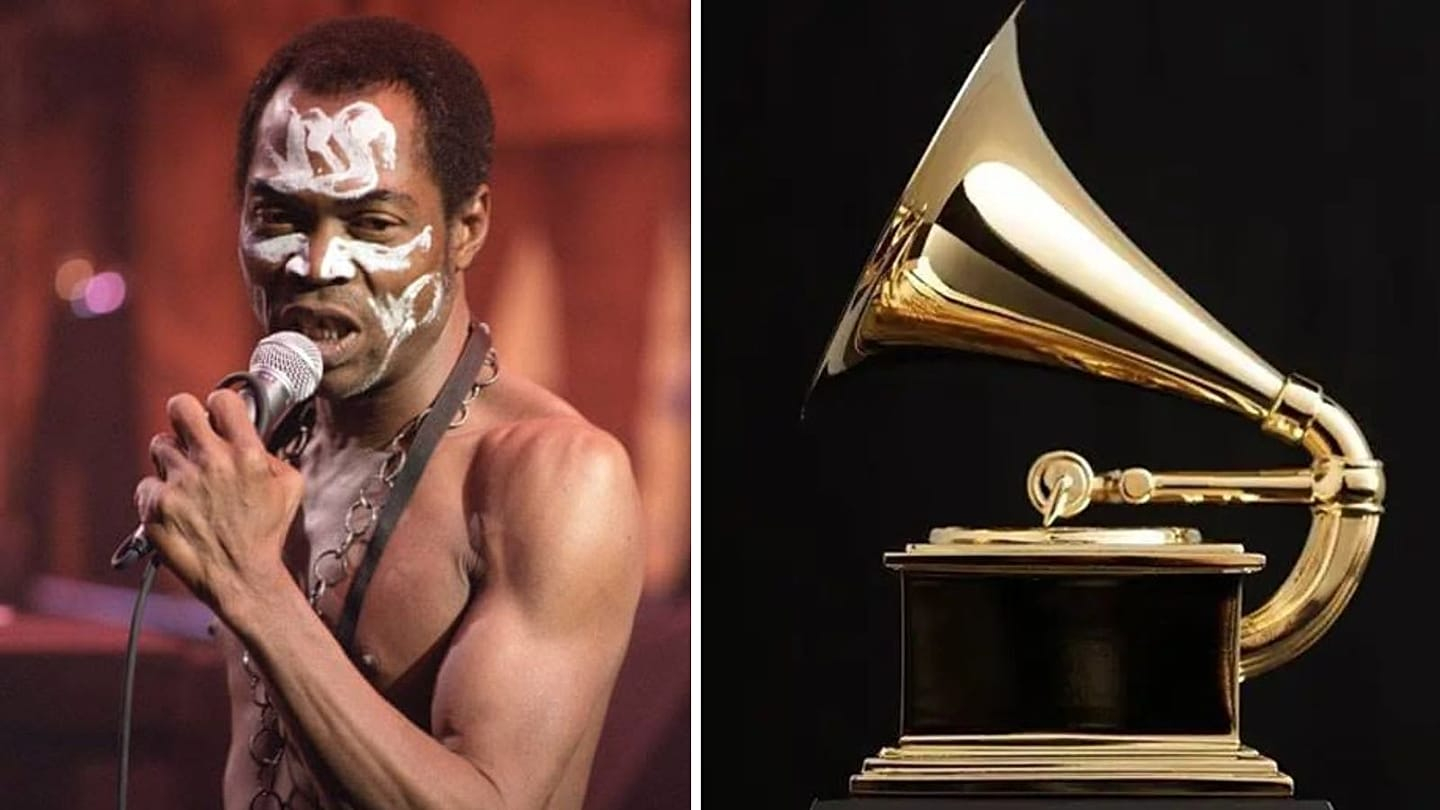
Fela Anikulapo Kuti, the “Abami Eda” himself, received zero Grammy awards during his lifetime. In fact, he was never even nominated for one while he was alive.
It was only on February 1, 2026, nearly three decades after his death, that the Recording Academy posthumously honored him with the Grammy Lifetime Achievement Award, making him the first African artist to receive this specific distinction. His iconic album Zombie was also inducted into the Grammy Hall of Fame in 2025.
While his family accepted the honor with a “better late than never” sentiment, those who know Fela’s philosophy understand that the man who called himself “The Black President” would likely have had a very different reaction.
Fela Would Have Rejected Lifetime Grammy Award if he was Alive
By: A Soul Who Knows the Rhythm
Listen! The “International Thief Thief” (I.T.T.) has come again, but this time they are bringing a gold-plated gramophone to a grave they helped dig with their silence. They call it “Lifetime Achievement.” I can hear Fela’s laughter from the Great Shrine in the sky—a deep, mocking cackle that would shake the very foundation of the Crypto.com Arena in Los Angeles.
If Fela were standing here today, bare-chested, a cigarette in one hand and a saxophone in the other, he wouldn’t be thanking the Academy. He would be asking them: “Which life are you achieving? The one you ignored when soldiers were jumping my fence? The one you turned your back on when they threw my mother from a window?”
The Trap of Western Validation
For Fela, the Grammys were not a goal; they were a symptom of what he called “Colonial Mentality.” He understood that when the West gives you an award, they are often trying to “domesticate” your rebellion. To Fela, music was not “for enjoyment.” It was a weapon. You don’t ask the person you are attacking to give you a medal for how well you swing your sword.
By accepting a Grammy, Fela would have felt he was joining the “Gentleman” class—the suit-wearing, tie-donning “puppets” he spent his life lampooning. He didn’t want to be a “Global Icon” in a Western gallery; he wanted to be the voice of the suffering man in the face of “Authority Stealing.”
Why Now?
The irony is thick like Lagos traffic. They wait 29 years after a man is buried to tell us he was “significant.” In Fela’s psyche, this isn’t honor—it’s institutional guilt. It is the establishment realizing they cannot tell the story of 21st-century music without the man they once treated as a criminal.
Fela would have seen right through the “Afrobeats” craze that the Grammys are currently chasing. He would have told the young stars—the ones “shuffering and smiling” for Western charts—that they are trading their souls for a plastic trophy.
“Teacher Don’t Teach Me Nonsense”
If a messenger arrived at Kalakuta Republic with this award in 1985, Fela would have probably used the trophy as a prop in a “Yabis” session at the Shrine. He would have told the Recording Academy: “You want to honor me? Then tell the World Bank to stop sucking my people’s blood. Tell the puppet governments to stop the ‘Zombie’ behavior. But don’t bring me your ‘Lifetime’ nonsense when you didn’t care about my life when I was in chains.”
Fela’s legacy doesn’t live in a trophy case in California. It lives in every heart that refuses to bow to a corrupt leader. It lives in the “Big Blind Country” that is finally waking up. He didn’t need the Grammys to be a King; he was already the President of a Republic that had no borders, only rhythms.
To give Fela a Grammy now is like putting a silk shirt on a lion after you’ve caged him. The lion doesn’t want the shirt. He wants to be out in the wild, roaring the truth until the walls of the palace come crumbling down.
The 2026 Special Merit Awards marked a historic moment for African music, as the Recording Academy finally extended its highest honors to the continent’s foundational icons.
While Fela Kuti was the centerpiece of the posthumous honors, he was joined by a select group of pioneers whose influence paved the way for the global “Afrobeats” explosion seen today.
African Icons Honored at the 2026 Special Merit Awards
-
Fela Kuti (Lifetime Achievement Award): The “King of Afrobeat” became the first African artist to receive this specific distinction. The Academy recognized his role in creating a brand new genre and his lifelong commitment to using music as a tool for social and political change.
-
Miriam Makeba (Lifetime Achievement Award): Known as “Mama Africa,” the late South African singer and civil rights activist was also honored posthumously. The Academy highlighted her role in bringing African music to the global stage in the 1960s and her tireless work against apartheid.
-
Manu Dibango (Trustees Award): The Cameroonian saxophonist and songwriter, famous for the 1972 hit “Soul Makossa,” was recognized for his immense technical contributions to music. His work is often cited as a bridge between traditional African rhythms and modern disco/funk, famously sampled by artists like Michael Jackson and Rihanna.
2026 Grammy Hall of Fame Inductions
In addition to the individual awards, the Academy inducted two seminal African works into the Grammy Hall of Fame this year:
-
“Zombie” by Fela Kuti & Afrika 70 (1976): Recognized as a definitive masterpiece of political protest and rhythmic innovation.
-
“Pata Pata” by Miriam Makeba (1967): Celebrated as one of the most successful and enduring African recordings in history.
The “New Guard” at the 68th Grammys
While the elders were honored for their “Lifetime” contributions, the younger generation dominated the competitive categories during the main ceremony:
-
Best African Music Performance: This category, now in its third year, saw heavy competition between Burna Boy, Tyla, and Davido.
-
Global Music Album: Artists like Wizkid and Tems continued to represent Nigeria, with the Academy noting that the “African sound” is no longer a niche sub-genre but a dominant force in global pop music.
This year’s ceremony felt like a formal reconciliation between the Western music establishment and the African continent—an acknowledgment that the history of modern music is incomplete without the rhythms of Lagos, Johannesburg, and Douala.