
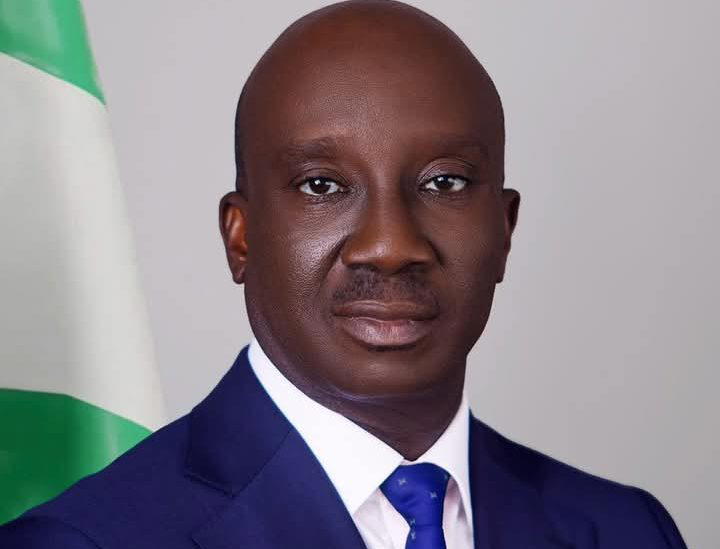
By John Maiyaki
This piece examines how Governor Monday Okpebholo’s construction drive is reshaping Edo State’s economy and infrastructure.
Positive news about Edo State has been further validated by several videos that emerged on the internet by Edo citizens who travelled home during the Yuletide and most especially repeated inspection of the state governor, Senator Monday Okpebholo to project sites. This optimism is largely driven by the multiple construction sites spread across the state, which have ignited economic activities and accelerated infrastructural development.
Just recently, the governor approved Ukpenu-Emuhi-Ugiamen-Ehor Road for construction and that of Iruekpen-Ozalla-Sabo road construction.
Already, and at a strategic junction along the Benin-Auchi and Benin-Asaba expressways is the ongoing construction of the first-ever flyover bridge being constructed by the Edo State government. It is situated at Ramat Park in Benin City corridor.
Also, two more flyovers are to be built; one at Dawson Road Junction and another at Sapele Road/Adesuwa Road Junction and this one is already ongoing.
Okpebholo’s infrastructure push also encompasses reconstruction and rehabilitation of critical routes such as Benin-Sapele-Warri, Benin-Agbor-Asaba corridors, Ekpoma-Uromi-Ubiaja stretches, Uromi-Onewa-Udomi-Ibhiolulu-Afuda-Idumoza Road, and urban thoroughfares like Upper Mission Road and portions of the Benin-Auchi Road.
Work is also nearing completion on the Auchi-Igarra-Ibillo Road, where more than 45 failed portions are being fixed to improve travel through Akoko-Edo Local Government and link to neighbouring states.
Within Benin and its environs, projects include Catholic Charismatic Renewal Church Road with erosion control works, reconstruction of Palace Road off Upper Mission Extension, and rehabilitation of Boundary Road. Long-standing thoroughfares such as the Benin-Sapele-Warri Road are being reconstructed with reinforced concrete pavement, and the governor has personally inspected and pushed for completion of sections like the Old Sapele Road and Ogheghe Road off Sapele Road to ensure timely delivery.
How did Okpebholo get the state out of its infrastructure deficit? What strategies is he deploying to leverage the economy through massive job creation and employment?
The answer lies in the implementation of well-thought-out social and economic policies and programmes designed to empower the people and stimulate economic growth.
Simply put, Okpebholo is pumping money into Edo’s economy through sustained investment in infrastructure. It would interest you to note that increased government spending has a direct impact on the people, making a significant difference by legitimately distributing wealth across urban and grassroots communities.
Once an economy is boosted through massive spending on productive activities, positive change becomes inevitable.
For instance, a typical road construction project provides employment for a wide spectrum of people ranging from skilled and unskilled labourers to vendors and service providers who earn income on a daily or weekly basis.
From Akoko-Edo to Etsako, from Owan to Esan, and down to the state capital, Edo state is dotted with massive construction sites. These projects impact communities directly, driven by the huge resources that have been deployed for road and drainage construction. This is Okpebholo’s deliberate pathway to economic stimulation.
Local content also plays a critical role. The increased use of locally sourced materials such as cement, stone, and concrete is designed to strengthen the local economy. The same applies to local contractors, local bitumen production, and indigenous service providers within the construction ecosystem.
Beyond this, significant growth is expected in quarrying, mineral production, cement manufacturing, and allied construction industries. Sustained construction activity remains a proven pathway to economic recovery; a path the Okpebholo administration is clearly charting.
In a bid to ensure more labour-intensive road construction, the Okpebholo administration has introduced concrete pavement alongside bitumen in the construction industry. This policy not only creates more jobs but also increases the use of locally available materials, thereby improving economic productivity.
Road infrastructure also leads to capital appreciation. These projects increase land value and stimulate the supply chain including food vendors, lubricant suppliers, laterite dealers, cement distributors, steel reinforcement suppliers, water vendors, and diesel suppliers across Edo South, Edo Central, and Edo North.
Additionally, subcontractors specializing in lane marking, road signage, and electrical fittings benefit significantly from these projects. It is noteworthy that Governor Okpebholo is executing several federal road projects purely to alleviate the suffering of the people, rather than making excuses.
Edo State’s spending on infrastructure runs into billions of naira, contributing significantly to the state’s recovery from infrastructural deficits while promoting inclusive and sustainable growth.
The post How Okpebholo is boosting economy in Edo appeared first on Vanguard News.