

The risk from the deadly Ebola outbreak has been raised to the highest level for the Democratic Republic of Congo, the World Health Organisation said Friday, as the toll continues to rise.
The WHO upgraded its risk assessment level from high to very high for the DR Congo, while keeping the regional risk level at high and the global risk level at low.
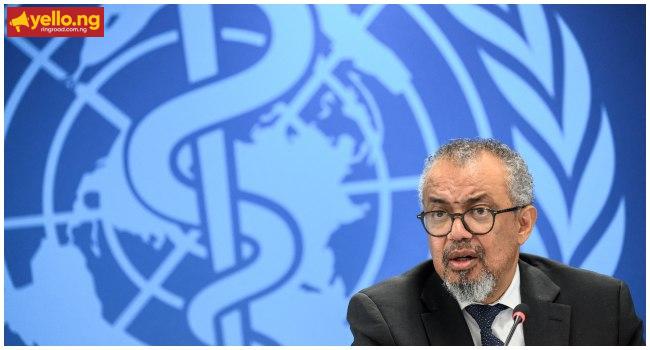
WHO chief Tedros Adhanom Ghebreyesus said the situation was “deeply worrisome”.
He said there were now nearly 750 suspected cases in the DR Congo and 177 suspected deaths, as health workers scramble to track down contacts of everyone thought to be infected with the virus.
“The Ebola outbreak in the Democratic Republic of the Congo is spreading rapidly,” he told a press conference.
“So far, 82 cases have been confirmed in DRC, with seven confirmed deaths.
“But we know in people who travelled from DRC and one death.
Measures to address the epidemic in DRC are much larger. There are now almost 750 suspected cases and 177 suspected deaths.”
He said the situation in Uganda was “stable”, with two cases confirmed in Uganda, including “intense contact tracing” and calling off the Martyrs’ Day commemorations, “appear to have been effective in preventing the further spread of the virus”, Tedros added.
While a US national who was working in the DRC has tested positive and been transferred to Germany for care, Tedros said another US national deemed to be a high-risk contact had been transferred to the Czech Republic.
Besides national staff already in the DRC, he said 22 international staff had been deployed to the field, “including some of our most experienced people”.
Tedros said that violence and insecurity were impeding the response to the outbreak in the DRC.
“We are now revising our risk assessment to very high at the national level, high at the regional level, and low at the global level.
“So far, 82 cases have been confirmed in DRC, with seven confirmed deaths.
“But we know the epidemic in DRC is much larger. There are now almost 750 suspected cases and 177 suspected deaths.
“The situation in Uganda is stable, with two cases confirmed in people who travelled from DRC, with one death.”
Tedros said that violence and insecurity were impeding the response to the outbreak.
– Treatment trials planned –
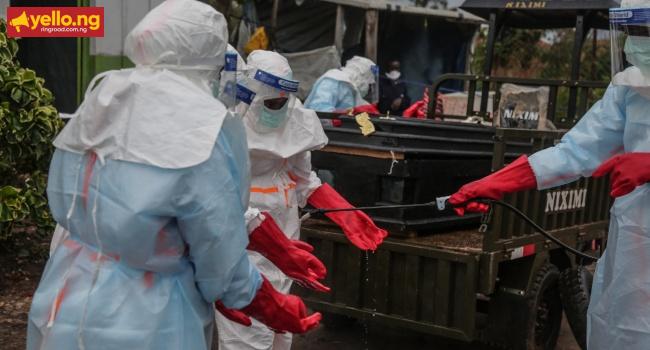
Ebola is a deadly viral disease spread through direct contact with bodily fluids. It can cause severe bleeding and organ failure.
There are no approved vaccines or therapeutics for the Bundibugyo strain of Ebola behind the current outbreak.
There have only been two previous outbreaks of Bundibugyo, in Uganda in 2007 and DRC in 2012.
WHO chief scientist Sylvie Briand said the UN agency was making an inventory of all existing tools which might be useful in combating the outbreak and then prioritising them, with safety and efficacy the main criteria.
The WHO research and development branch has convened its technical advisory group on treatments, which recommended the prioritisation of two monoclonal antibodies for clinical trials.
It also recommended evaluating the antiviral obeldesivir in clinical trials as post-exposure prophylaxis for people who are high-risk contacts.
Briand said it looked “promising” as something that might be able to prevent infected contacts from going on to develop disease from that infection.
The WHO is also in talks with partners on developing eventual vaccines that work against Bundibugyo.
Riots Hit Hospital
Rioters have burnt down hospital tents in a hotspot of the Democratic Republic of Congo’s Ebola epidemic, as many Congolese wrestle with fear, anger and confusion over the latest deadly outbreak.
The hastily arranged burials of the victims suspected to have been killed by the viral haemorrhagic fever have been met with suspicion in a conflict-ridden part of the country already distrustful of the state.
With tensions running high, the military has been deployed to provide security for funerals.
Tents used to isolate Ebola patients at Rwampara hospital, in the northeastern Ituri province at the outbreak’s epicentre, were torched in the riot on Thursday, which ended swiftly after the army stepped in. Only the tents’ charred husks remain.
“It all kicked off when a 24-year-old man, the son of a soldier, died at the hospital,” an official at the medical institution said.
“The family wanted us to hand over his body so that they can bury him, but given the circumstances, that’s impossible,” the official added.
Besides being extremely deadly, Ebola is transmitted through prolonged physical contact and bodily fluids.
There is no vaccine or treatment for the Bundibugyo strain responsible for the 17th Ebola outbreak to hit the vast central African country, which the World Health Organization believes has already killed more than 177 people.
So attempts to tackle the latest spread have been forced to rely mainly on precautions and rapid contact tracing.
But in rural parts of the DRC, “loved ones are throwing themselves at the bodies, touching the corpses and the clothes of the deceased, while organising mourning rituals bringing together loads of people,” said Jean Marie Ezadri, a civil society leader in Ituri.
“Unfortunately, this is going on even during this epidemic, which explains the many instances of contamination.”
– ‘Imaginary disease’ –

After the riot at Rwampara hospital, families nervously awaited the burials of three patients suspected to have died of the virus — though some questioned its existence.
“My brother is not dead from Ebola, it’s an imaginary disease,” said 22-year-old Jeremie Arwampara.
“Why are they refusing to give us the bodies? He’s my big brother, I cannot be afraid of him,” yelled Ezekiel Shambuyi.
The unruly rabble dispersed after the soldiers on guard around the hospital fired warning shots. A nurse was wounded by stones thrown.
Within the shelter of the hospital’s walls, healthcare workers prepared for the burials, slipping into full protective gear.
Finally, they emerged carrying three black-and-white caskets, placed on a three-wheeled cart.
In one lay the father of Musa Amuri, who came to bid his dad a rushed goodbye.
“They’re going to bury our father without us seeing him, it breaks my heart,” the young man said.
The funeral procession set off to the Rwampara cemetery, escorted by three jeeps full of soldiers and police.
Infamous for their indiscipline, Congolese security forces have been accused in past Ebola outbreaks of fanning distrust towards medics.
Even some of the Rwampara rioters were themselves soldiers, close to one of the victims, who threatened the healthcare workers, according to a hospital source.
– Funeral hymn –
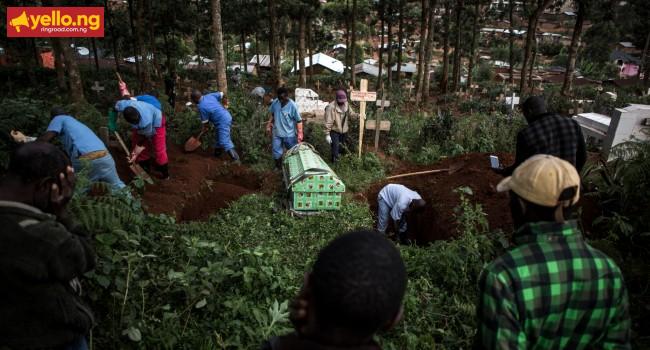
Dusk fell over Rwampara’s surrounding green hills as the burial began at the cemetery away from the town.
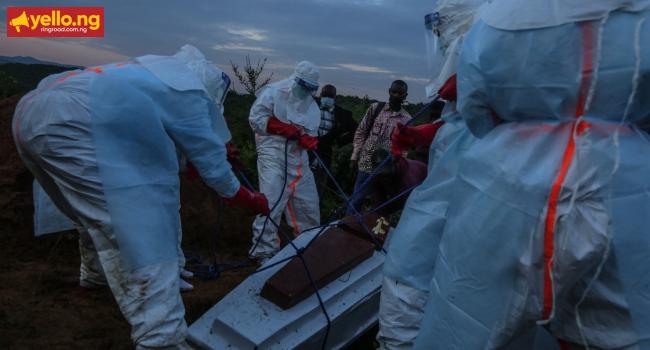
After being sprayed with disinfectant, the coffins were quickly lowered into the earth by faceless men clad in full hazmat suits.
Loved ones who came to witness the ceremony burst into tears. One struck up a dirge in a faint voice, while a pastor recited several verses from the Bible.
Among the funeral crowd, Maman Leonie refused to believe that her brother had been killed by Ebola.
“He was just sick, let the government come to our aid!” she pleaded.
State services in rural areas of Ituri have been largely absent for decades.
And its inhabitants, already prey to the repeated massacres committed by the restive province’s rash of armed groups, are increasingly blaming the Congolese government for the slow response to the outbreak.
Over the past few days in the town of Mongbwalu, “the population has understood the scale of the situation and now knows that bodies must not be touched,” a hospital official said.
But they fretted about the fact that “isolation and triage areas have still not been set up”.
“Suspected cases are mixed in with other patients in the hospital wards, with a high risk of infection.”
The post UPDATED: Ebola Risk Now At Highest Level In DR Congo, Says WHO appeared first on Channels Television.