
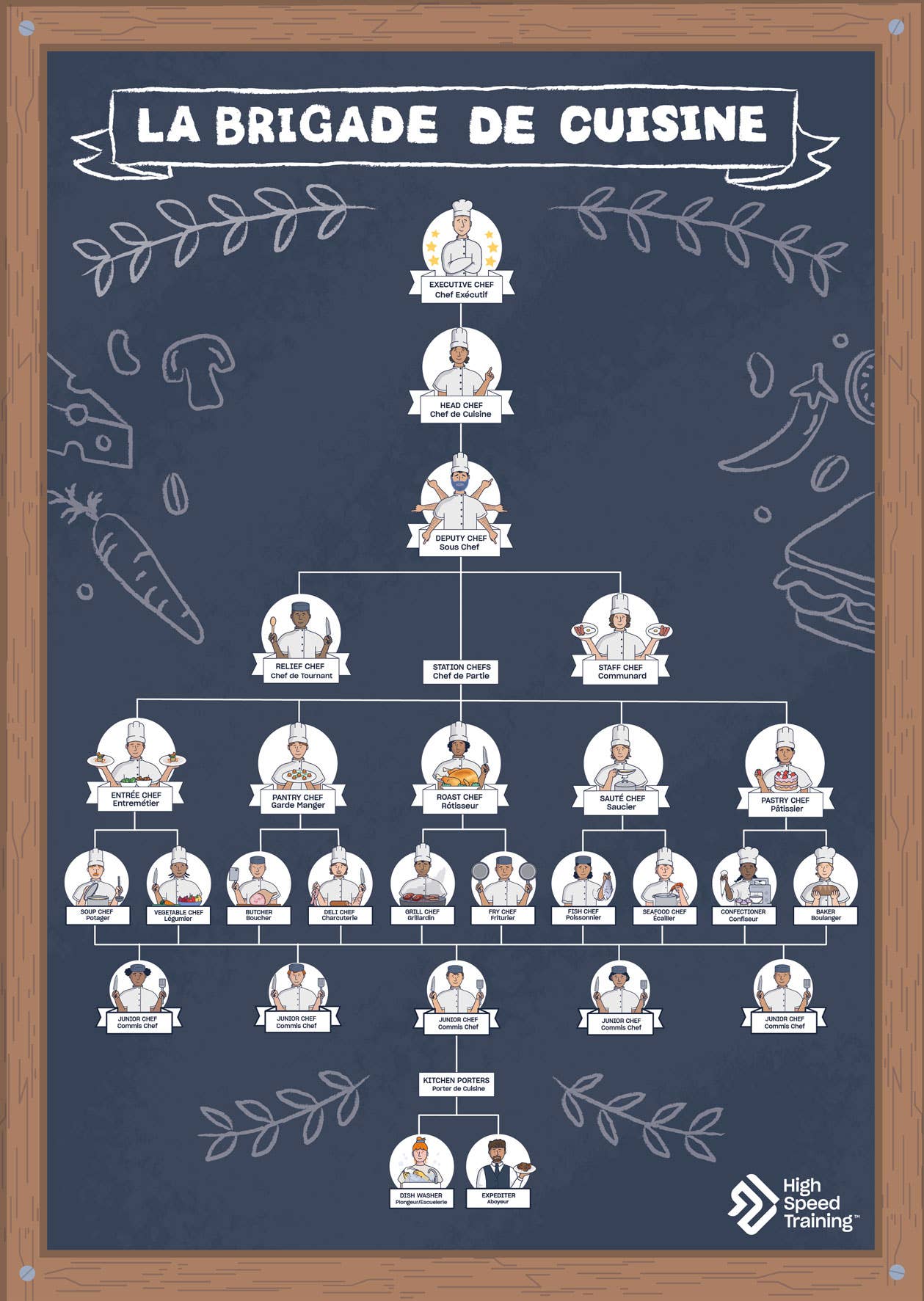
You’re unlikely to come across a lot of French job titles during your quest for employment, that is, unless you’re a chef – cue the French Brigade system (or Brigade de cuisine). All modern professional kitchens run according to a strict hierarchy, with the French Brigade system used in order to ensure the whole operation runs as smoothly as possible. The structure will vary slightly depending on the size and style of the restaurant, however as a chef it’s important to know and understand the many positions held within a professional kitchen. Even if you’re not a chef, knowing what ‘sous chef’ means is a sure fire way to impress your friends while watching Gordon Ramsay’s Kitchen Nightmares.
https://din.i.ng lets dine !
In the name of logic, we’ll start from the top of the hierarchy and work our way down the chain, explaining the array of titles and what they involve as we go!
Executive Chef (aka Group Chef) –
The very top of the kitchen management structure. Only the largest establishments have an executive chef, and it is primarily a management role; executive chefs are often responsible for the operation of multiple outlets, and thus they do very little actual cooking!
Head Chef (aka Executive Chef, Chef de Cuisine) –
Chef de Cuisine is the traditional French term, and although it’s slightly more common in European kitchens, head chef is the title that’s used most prevalently around the world. The head chef generally controls the whole kitchen, from managing kitchen staff and controlling kitchen costs to liaising with suppliers and creating the menus. Depending on the restaurant and the individual themselves, much like CEO’s of the corporate world the head chef will often leave much of the day-to-day running of the kitchen to individuals lower down the hierarchy, such as the sous chef.
Sous Chef (aka Second Chef) –
The sous-chef de cuisine is second in command, and translated it literally means ‘under chef’. The role will typically overlap with the head chef’s, but the sous chef will tend to be more hands on and actively involved in the day-to-day running of the kitchen; the sous chef will also fill in for the head chef when they are off, as well as a chef de partie when needed. Some smaller kitchens may not even have a sous chef, while larger operations can have more than one – there are also a few variations that can precede the title to further specify hierarchy; executive, junior or senior.
Chef de Partie (aka Station Chef, Line Chef, Line Cook) –
Ever heard of the expression ‘too many cooks spoil the broth’? This is why chef de parties are a vital part of the brigade system. Each chef de partie is responsible for running a specific section of the kitchen (we’ll cover these below), and they are usually the only worker in that department, although in some larger kitchens each station chef may well have several assistants. Again, this is a term that can have multiple hierarchical precedents, such as junior or senior.
Specific Chef de Partie titles can include the following:
- Butcher chef (aka boucher) – In charge of preparing meats and poultry before they are delivered to their retrospective stations, the butcher chef may also handle fish and seafood preparations.
- Fish chef (aka poissonnier) – An expert in the preparation of fish dishes, and often responsible for fish butchering as well as creating the appropriate sauces.
- Fry chef (aka friturier) – This individual specialises in the preparation of fried food items.
- Grill chef (aka grillardin) – As the name implies, the master of all foods that require grilling.
- Pantry chef (aka garde manger) – A pantry chef is responsible for the preparation of cold dishes, such as salads and ptés.
- Pastry chef (aka patissier) – The King or Queen of the pastry section; baked goods, pastries and desserts are this chefs forte.
- Roast chef (aka rotisseur) – Responsible for the preparation of roasted meats and the appropriate sauces.
- Roundsman (aka chef de tournant, swing cook, relief cook) – Someone who fills in as needed on all of the stations, rather than having a specific job.
- Sauté chef (aka saucier or sauce chef) – Often the most respected role in the brigade system of stations, reporting directly to the head chef or sous-chef. They’re responsible for sautéing foods, but their most vital role lies within the creation of the sauces and gravies that will accompany other dishes.
- Vegetable chef (aka entremetier) – Prepares vegetables, soups, starches, and eggs. Larger establishments may employ multiple chefs to work this station. A potager would be in charge of making soups, and a legumier would be in charge of preparing any vegetable dishes.
Commis Chef –
A commis is a junior member of staff that works under a chef de partie in order to learn the ins and outs of a specific station, these are often people that have recently completed, or are still undertaking, formal culinary training.
Kitchen Porter (aka Kitchen Assistant or Kitchenhand) –
These are workers that assist with rudimentary tasks within the kitchen, and are less likely to have any formal culinary training. Tasks include basic food preparation such as washing salad and peeling potatoes, in addition to basic cleaning duties.
Dishwasher (aka Escuelerie)
The person responsible for washing dishes and cutlery, and even they get a fancy title! It derives from the word ‘scullery’, which is described as a “small room adjoining a kitchen, in which dishwashing and other kitchen chores are done”.
pls Share
Pin
•••
BY LORRI MEALEY Updated February 04, 2018
Maybe you’re thinking about opening your own restaurant, or maybe you just want to work in a dining establishment. In either case, it can pay off to have a fundamental knowledge of staff needs and the positions involved, from types of chefs down to line cooks as well as noncooking roles.
Positions are numerous and are divided between “back” and “front” of house. Front of house is where diners gather to enjoy the food, and back of house is where the food is prepared.
Chef or Cook?
Depending on the size and theme of a restaurant, just one cook might run the show or several cooks might work together back of house in the kitchen. The terms chef and cook are often used interchangeably. Originally, a chef was a professionally trained individual. Today, the term is often applied to anyone who works in a kitchen.
The Executive Chef
The executive chef is the head chef—the person who designs the menu, creates the specials, orders the foods, and serves as the general manager of the kitchen. The executive chef typically handles scheduling, hiring, and firing of kitchen staff as well, and is responsible for the quality of the food that leaves the kitchen. Every detail of the kitchen’s operation traces back to the executive chef.
This position is normally filled by someone with several years cooking and restaurant management experience, and/or a culinary degree. A knack for detail and the ability to thrive in a fast-paced environment can be critical. Average base pay is about $59,000 a year as of 2018, but it can be considerably more in major metropolises and upscale establishments.
The Sous Chef
The sous chef is the executive chef’s assistant and the next in command. It’s the sous chef’s job to take over operations when the executive chef has a day off or is on vacation. Sous chefs might fill in on the line or work a particular station on busy nights.
Many smaller restaurants do not keep a sous chef on staff, but this position requires the same skills, experience, and training as that of executive chef among establishments that do. It is, in fact, a stepping-stone to that loftier position. Understandably, sous chefs earn less, an average base pay of just under $46,000 a year. But again, this can be higher depending on the location and the restaurant.
The Line Cooks
The most common title in the kitchen is that of the line cook, and it does not refer to just one position or job duty. Depending on the kitchen setup and the menu, a restaurant might have anywhere from two to eight or more line cooks. A line cook refers to anyone in charge of a particular station in the kitchen, such as:
Sauté Chef: This person is in charge of anything cooked in a sauté pan. The position is typically filled by the best cook on staff behind the executive chef and the sous chef.
Grill Cook: This cook takes care of everything prepared on the char-grill or flattop grill, such as meats, chicken, and fish.
Fry Cook: This is an entry-level position in the kitchen. The fry cook is in charge of anything that requires deep-frying. French fries, chicken fingers, onion rings … all fall to this individual.
Virtually no kitchen is without at least one line cook, including fast-food establishments, and a single line cook can staff more than one station in slower restaurants. Line cooks earn an average base pay of about $26,000 a year as of 2018. If you’re looking to start out in the industry, this position can give you a great toehold to move up after you master one or more stations.
Other Types of Chef Positions
Larger restaurants or those with very specialized menus often employ other types of chefs as well.
Dessert Chef: Many restaurants require that their servers prepare their own desserts, but a dessert chef prepares a bulk of the desserts as they are ordered in more upscale or specialty eateries.
Pastry Chef: This individual is in charge of making all the baked goods, including breads and desserts.
Salad Chef: A restaurant that offers a lot of salads and other cold menu items might keep a salad chef on hand to prepare and oversee these dishes.
The Expeditor
Someone has to keep the pace moving along at an efficient speed, a job that falls to the expeditor. This is a noncooking role on the kitchen line. An expeditor is in charge of organizing orders by table and garnishing the dishes before the server takes them out to the dining room. Expeditors are only needed when the kitchen is exceptionally busy, which can be all the time in some popular establishments. This role often acts as a liaison between back and front of house.
The person who acts as an expeditor must be very familiar with the menu and know what dishes should look like when they leave the kitchen and are served to guests. Communication skills are important.
The Caller
Another noncooking position, this employee calls the incoming orders to the cooks and tells the rest of the kitchen staff what they should be working on. The executive chef often acts as the caller during the dinner rush.
A caller needs to be quick-witted and highly organized, knowing exactly how long each menu item takes to prepare. A well-done prime rib requires much more time than a rare grilled tuna steak, and timing must be balanced if both are ordered by the same table and must come out at the same time.
Hiring the Right Person
Hiring the right person for each job—or, if you’re looking for a position, knowing the right job to apply for—can be critical. Employees must be able to work together efficiently and communicate effectively no matter how many positions a restaurant kitchen requires. Making sure that your staff is trained to do a variety of tasks can also help keep the flow of the kitchen smooth, ensuring that customers get the best possible food in a timely manner.