

The day Thomas Blood stole the Crown Jewels
Dominic Sandbrook explores the events of 9 May 1671, when Colonel Thomas Blood, an Irish-born adventurer, walked audaciously into the Tower of London and stole significant pieces of the Crown Jewels…

At the head of the approaching party was a man Edwards knew well, even though they had only met weeks before. One day in April, a parson called Dr Ayliffe had brought his wife to view the crown jewels. This was nothing unusual: Edwards’s contract allowed him to charge visitors a small fee for the privilege of seeing them. But while the visitors had been inspecting the treasure, Mrs Ayliffe was taken ill.
What are the Crown Jewels?
A collection of royal crowns, robes, and other ceremonial objects associated with the kings and queens of England dating back more than 600 years.
Since the 1600s, the Crown Jewels have been kept at the Tower of London. Often said to be priceless, the Crown Jewels are, at best estimate, probably worth more than £20 billion.
Nearly three million people flock to the Tower of London every year to see them. Today the hundreds of pieces that make up the collection rest on French velvet, in cases made of 5cm-thick shatterproof glass. Visitors must pass through vault doors that, it’s said, can withstand a nuclear explosion.
The Crown Jewels are working regalia, and are regularly used by the royals for national ceremonies. The Imperial State Crown, for example, is usually worn by the monarch for the State Opening of Parliament.
Playing up to his role as the gallant ex-soldier, Edwards offered her some spirits and even invited her up to his apartment, where his wife and daughter helped her to recover. Such Christian charity made a great impression on Dr Ayliffe, who returned a few days later with a gift of white gloves for Edwards’s family. So the two men became friends. And at last, one day, Dr Ayliffe suggested that Edwards’s daughter would make a fine match for his nephew, Thomas, who was on the lookout for a wife.
At first the wedding morning seemed to be going swimmingly. While they were all waiting for Mrs Ayliffe, the parson suggested that Edwards let his friends look at the famous jewels. So down they went to the basement – and then, as soon as the door closed behind them, Dr Ayliffe grabbed the old man, threw a cloak over him and jammed a wooden plug into his mouth, hissing that he would come to no harm if he stayed quiet. But Edwards struggled so much that his assailant was forced to give him some “unkind knocks on the head” with a mallet.

The gang was wasting no time. While Dr Ayliffe was flattening St Edward’s Crown so that he could stuff it under his clerical robe, one of his friends was sawing the royal sceptre in two so that it would fit under his clothes, while a third man, comically, stuffed the orb down his trousers. But now their plan began to unravel. Spitting out his gag, Edwards shouted: “Treason! Murder! The crown is stolen!”
Dropping the sceptre, the robbers tried to make a run for it, guards firing at them across the Tower complex. In the confusion of the chase, they dropped the orb and the crown, too, and at last the king’s men had them. At the centre of the melee was the so-called Dr Ayliffe, apparently quite undaunted by his failure. “It was a gallant attempt, however unsuccessful!” he loudly remarked. “It was for a crown!”
By the time the ringleader was dragged before Charles II, his real identity had been revealed. Far from being an ordinary country parson, he was the splendidly named Colonel Thomas Blood, an Irish-born adventurer who had fought for both sides in the Civil War and engaged in various conspiracies since the Restoration. And far from feeling sorry for his adventure, he seemed positively proud of it, telling his captors that he would answer only to the king in person.
Indeed, when Charles interrogated him, three days after the attempted robbery, Colonel Blood cut a gloriously unrepentant figure. He had even once tried to assassinate the king while Charles was swimming in the Thames, he confided, but “his heart misgave him out of awe of His Majesty”.
At that, some kings would have had Blood executed on the spot. But that was not Charles II’s style. The Merry Monarch rather liked this suave Irish adventurer. By early August one courtier spotted the colonel strolling around Whitehall, wearing a “new suit and periwig”. Blood was “extraordinary pleasant and jocose,” the observer wrote; “he has been at liberty this fortnight”.
Two weeks later, Charles handed him a full pardon. Blood even went on to become a secret agent for the royal administration. Crime, it seemed, did pay after all. We can only imagine what Talbot Edwards made of it.
Dominic Sandbrook is a historian who has written widely on postwar Britain.
more
The Theft of the Crown Jewels
by Ben Johnson
One of the most audacious rogues in history was Colonel Blood, known as the ‘Man who stole the Crown Jewels’.
Thomas Blood was an Irishman, born in County Meath in 1618, the son of a prosperous blacksmith. He came from a good family, his grandfather who lived in Kilnaboy Castle was a Member of Parliament.
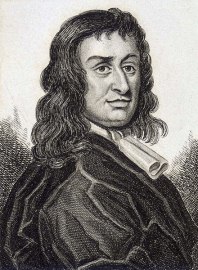 The English Civil War broke out in 1642 and Blood came to England to fight for Charles I, but when it became apparent that Cromwell was going to win, he promptly changed sides and joined the Roundheads.
When Charles I was defeated in 1653 Blood was made a Justice of the Peace and was granted a large estate, but when Charles II returned to the throne in 1660 Blood fled to Ireland with his wife and son.
In Ireland he joined a plot with the disgruntled Cromwellians and attempted to seize Dublin Castle and take the Governor, Lord Ormonde prisoner. This plot failed and he had to flee to Holland, now with a price on his head. in spite of being one of the most wanted men in England, Blood returned in 1670 taking the name Ayloffe and practised as a doctor in Romford!
After another botched attempt to kidnap Lord Ormonde in 1670, where Blood narrowly escaped capture, Blood decided on a bold scheme to steal the Crown Jewels.
The Crown Jewels were kept at the Tower of London in a basement protected by a large metal grille. The Keeper of the Jewels was Talbot Edwards who lived with his family on the floor above the basement.
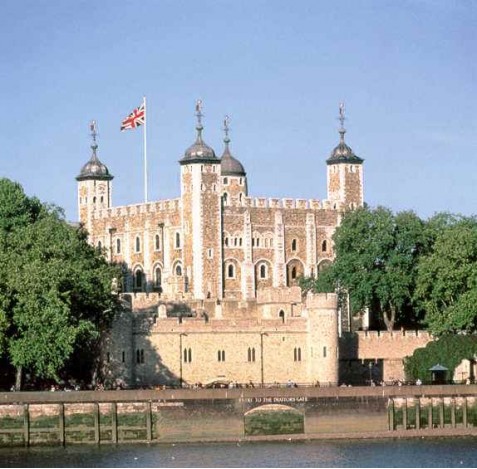
One day in 1671 Blood, disguised as a ‘parson’ went to see the Crown Jewels and became friendly with Edwards, returning at a later date with his wife. As the visitors were leaving, Mrs. Blood had a violent stomach-ache and was taken to Edward’s apartment to rest. The grateful ‘Parson Blood’ returned a few days later with 4 pairs of white gloves for Mrs. Edwards in appreciation of her kindness to his wife.
The Edwards family and ‘Parson Blood’ became close friends and met frequently. Edwards had a pretty daughter and was delighted when ‘Parson Blood’ proposed a meeting between his wealthy nephew and Edward’s daughter.
On 9th May 1671, ‘Parson Blood’ arrived at 7am. with his ‘nephew’ and two other men. While the ‘nephew’ was getting to know Edward’s daughter the others in the party expressed a desire to see the Crown Jewels.
Edwards led the way downstairs and unlocked the door to the room where they were kept. At that moment Blood knocked him unconscious with a mallet and stabbed him with a sword.
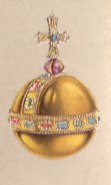
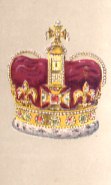
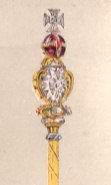
The grille was removed from in front of the jewels and the crown, orb and sceptre were taken out. The crown was flattened with the mallet and stuffed into a bag, and the orb stuffed down Blood’s breeches. The sceptre was too long to go into the bag so Blood’s brother-in-law Hunt tried to saw it in half!
At that point Edwards regained consciousness and began to shout “Murder, Treason!”. Blood and his accomplices dropped the sceptre and attempted to get away but Blood was arrested as he tried to leave the Tower by the Iron-Gate, after unsuccessfully trying to shoot one of the guards.
In custody Blood refused to answer questions, instead repeating stubbornly, “I’ll answer to none but the King himself”.
Blood knew that the King had a reputation for liking bold scoundrels and reckoned that his considerable Irish charm would save his neck as it had done several times before in his life.
Blood was taken to the Palace where he was questioned by King Charles, Prince Rupert, The Duke of York and other members of the royal family. King Charles was amused at Blood’s audacity when Blood told him that the Crown Jewels were not worth the £100,000 they were valued at, but only £6,000!
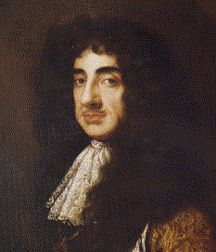 The King asked Blood “What if I should give you your life?” and Blood replied humbly, “I would endeavour to deserve it, Sire!”
Blood was not only pardoned, to the disgust of Lord Ormonde, but was given Irish lands worth £500 a year! Blood became a familiar figure around London and made frequent appearances at Court.
Edwards who recovered from his wounds, was rewarded by the King and lived to a ripe old age, recounting his part in the story of the theft of the Jewels to all the visitors to the Tower.
In 1679 Blood’s phenomenal luck ran out. He quarrelled with his former patron the Duke of Buckingham. Buckingham demanded £10,000 for some insulting remarks Blood had made about his character. As Blood became ill in 1680 the Duke never got paid, as Blood died on August 24th of that year at the age of 62.
The Crown Jewels have never been stolen since that day – as no other thief has tried to match the audacity of Colonel Blood!