

The total area of Africa is 30.4 million square kilometers (11.7 million square miles). The total area of the United States (including Alaska and Hawaii) is 9.6 million square kilometers (3.8 million square miles). Africa is more than three times the size of the US.
For A United States there are usually Disunited States .
Most United States had to go through a WAR of Sorts to get to where they are .Most African States were Formed from Independence from such States
Lets Look at Specifics
By Land Area
Here’s a breakdown of the world’s continents by land area, from largest to smallest:
| Continent | Area (sq km) | Area (sq mi) | Percentage of Earth’s land |
|---|---|---|---|
| Asia | 44,579,000 | 17,212,048 | 30% |
| Africa | 30,065,000 | 11,508,000 | 20.3% |
| North America | 24,256,000 | 9,365,000 | 16.5% |
| South America | 17,819,000 | 6,880,000 | 12% |
| Antarctica | 13,209,000 | 5,100,000 | 9% |
| Europe | 9,938,000 | 3,837,000 | 6.8% |
| Australia | 7,692,000 | 2,970,000 | 5.2% |
By Population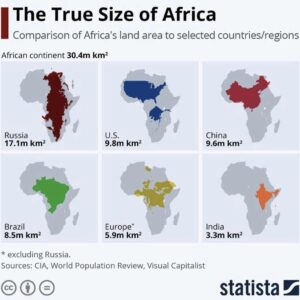
It’s interesting to note that the largest continent by land area is also the most populous.
| Continent | Population (approx.) | Percentage of World Population |
|---|---|---|
| Asia | 4.5 billion | 60% |
| Africa | 1.3 billion | 17% |
| Europe | 747 million | 10% |
| North America | 360 million | 5% |
| South America | 423 million | 6% |
A United States of Africa: A Complex Possibility
The idea of a United States of Africa is a compelling one, promising increased economic power, political influence, and security. However, the path to such a union is fraught with challenges.
Factors that could make it happen:
- Shared history and culture: Many African nations share common historical experiences, languages, and cultural ties.
- Economic interdependence: Increased trade and economic cooperation could foster unity.
- Shared threats: Common external threats, such as terrorism or climate change, could serve as a unifying force.
- Strong leadership: Visionary leaders capable of inspiring and uniting the continent.
- Successful regional integration: Building upon existing regional blocs like ECOWAS, SADC, and EAC.
Factors that could hinder it:
- Diverse cultures and languages: Africa is a continent of immense cultural and linguistic diversity.
- Political instability: Many African nations face political challenges, including corruption, conflict, and weak governance.
- Economic disparities: The gap between rich and poor nations within Africa is significant.
- Historical rivalries: Some countries have longstanding tensions and conflicts.
- External interference: Foreign powers may have interests in maintaining Africa’s division.
A Possible Path Forward
A gradual approach, focusing on building regional integration and cooperation, could be a more realistic path to eventual continental unity. This would involve:
- Strengthening existing regional economic communities.
- Promoting free trade and investment within Africa.
- Developing shared infrastructure projects.
- Enhancing security cooperation.
- Fostering people-to-people exchanges.
While challenges are substantial, the potential benefits of a united Africa are immense. It is a complex journey, but one that many believe is worth pursuing.
Would you like to explore the potential benefits of a United States of Africa in more detail, or perhaps discuss a specific African region?