
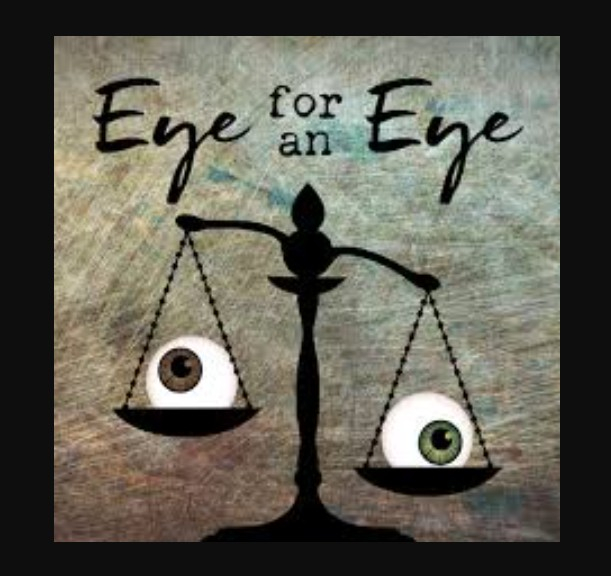
At first glance, it seems contradictory. “Love” is virtuous, “hate” is sinful. But if we look closer—spiritually and psychologically—the Bible, history, and human experience show it’s far more complex.
When Jesus tackled the “eye for an eye” concept during the Sermon on the Mount, he wasn’t just giving a lecture on being nice; he was essentially flipping a long-standing legal and social framework on its head.
To understand the “Love Your Enemy” part, we first have to look at what he was replacing.
1. The Old Standard: Lex Talionis
The phrase “an eye for an eye” (found in Exodus 21:24) is known as Lex Talionis, or the Law of Retaliation.
-
The Original Intent: It was actually designed to limit vengeance. In ancient times, if you knocked out someone’s tooth, they might try to burn down your entire village. The law stepped in to say: “No, justice must be proportional. Only one tooth for one tooth.”
-
The Problem: Over time, people began using this limit as a right to retaliate. It became a permission slip for “getting even.”
2. The Radical Pivot: “But I Say to You”
Jesus takes this legal limit on revenge and replaces it with a mandate for radical non-resistance and proactive grace. He offers three famous (and often misunderstood) examples:
| Example | The Cultural Context | The Subversive Response |
| Turn the other cheek | A backhanded slap to the right cheek was an insult to an inferior. | By offering the left cheek, you refuse to be humiliated and demand to be treated as an equal. |
| Give your cloak too | If someone sued you for your tunic (inner garment), you’d be left in your underwear. | By giving your cloak (outer garment) as well, you’d be standing there naked, shaming the person taking advantage of you. |
| Go the second mile | Roman soldiers could legally force a civilian to carry their gear for exactly one mile. | Going two miles seized the initiative. It turned a forced labor into a voluntary act of service, baffling the oppressor. |
3. The Climax: Love Your Enemy
This all leads to the “Love Your Enemy” command. Jesus argues that if you only love those who love you, you’re just doing what everyone else does.
“You have heard that it was said, ‘Love your neighbor and hate your enemy.’ But I tell you, love your enemies and pray for those who persecute you.” — Matthew 5:43-44
Why do this?
-
To Break the Cycle: Retaliation (even proportional retaliation) keeps the “eye for an eye” loop going until everyone is blind. Love is the only thing that introduces a new variable into the equation.
-
Reflecting the Divine: Jesus points out that the sun rises on both the good and the evil. By loving enemies, he suggests humans are acting in a way that mimics a “perfect” or “complete” divine perspective.
The Bottom Line
Jesus wasn’t suggesting people become doormats. Instead, he was advocating for a “third way”—not fighting back with violence, and not running away in fear, but standing your ground with a level of love and grace that makes the old “eye for an eye” system look obsolete.
It’s arguably the most difficult teaching in the New Testament because it requires giving up the one thing humans love most: the right to feel justified in our resentment.
1. Evil People Can Love
Spiritual Perspective
-
In the Bible, love is not limited to the morally perfect. Even people considered wicked can show genuine care, attachment, or sacrifice.
-
Example: King Saul (1 Samuel 18–19)
Saul was morally compromised—he sought David’s life out of jealousy—but he loved Jonathan, his son’s friend, deeply and faithfully. -
Spiritually, love can exist in an evil person as an instinct, a desire, or a fleeting grace. Love does not require moral perfection; it requires connection or affection.
Psychological Perspective
-
Psychologists distinguish between emotional love and moral love:
-
Emotional love: attachment, desire, protectiveness
-
Moral love: altruism, selfless concern
-
-
Case in modern history: Pablo Escobar reportedly loved his family fiercely, even though he orchestrated massive violence. His love was real, though morally compromised.
-
Psychological principle: Evil actions don’t always extinguish capacity for human attachment or empathy in limited spheres. Humans are morally complex.
2. Good People Can Hate
Spiritual Perspective
-
The Bible records righteous figures expressing hatred as a moral response to evil:
-
Psalm 139:21–22: “Do I not hate those who hate you, LORD? And do I not loathe those who are in rebellion against you?”
-
Jesus’ words in Matthew 23: He rebukes Pharisees harshly. His “hatred” is zeal against hypocrisy, not personal malice.
-
-
Spiritually, hatred can exist as a morally just response, especially when aimed at sin, injustice, or evil, even in a good person.
Psychological Perspective
-
Psychologists describe “righteous anger” or moral outrage:
-
Example: Modern whistleblowers, activists, or leaders may hate corrupt systems or perpetrators intensely.
-
This form of hatred is goal-directed, often aimed at justice or protection rather than destruction of individuals for pleasure.
-
-
Ancient example: King David hated the Philistines for their oppression, but still loved God and his people deeply. Hatred can coexist with goodness when morally oriented.
3. Ancient and Modern Biblical Examples
| Person | Nature | Love | Hate |
|---|---|---|---|
| Saul | Evil (jealous, unstable) | Loved Jonathan deeply | Hated David out of envy |
| David | Good (righteous king) | Loved his people and God | Hated injustice and oppressors |
| Jesus | Perfect | Loved sinners, disciples, enemies | Hated hypocrisy and evil (Matthew 23) |
| Jonah | Righteous but flawed | Loved Israel | Hated Nineveh’s mercy (Jonah 4:1–3) |
Lesson: Human and divine morality allow complex emotional landscapes: love and hate are not mutually exclusive in practice.
4. Modern Psychological Insights
-
Cognitive dissonance: A person can harbor love and hate simultaneously toward different objects or even the same person.
-
Example: Parents who are abusive may still deeply love their children.
-
Example: Leaders like Abraham Lincoln reportedly hated slavery (moral hatred) but loved and empathized with even opponents of his policies.
-
-
Attachment vs. morality: Love can exist for reasons unrelated to goodness—family bonds, desire, or instinct. Hatred can exist for reasons beyond selfishness—justice, protection, or moral outrage.
5. Spiritual & Psychological Synthesis
-
Love is not inherently moral; it is relational. An evil person can love within certain boundaries.
-
Hate is not inherently immoral; it can be righteous, disciplined, and targeted against wrongdoing.
-
Both love and hate can coexist within the same person, and even a spiritually “good” person can feel both in different directions.
-
Biblical principle: God’s love and God’s hatred are both purposeful:
-
Love seeks relationship, restoration, and life
-
Hatred seeks justice, opposition to evil, and holiness
-
Example for Illustration
-
Modern: Malala Yousafzai loves her father and family while hating the Taliban’s oppression.
-
Ancient/Biblical: Joseph forgave his brothers (love) but knew their betrayal was evil (righteous moral response, a form of divine justice).
➡️ Truth: Love and hate are tools of the human and divine moral compass, not automatic indicators of virtue or sin.