
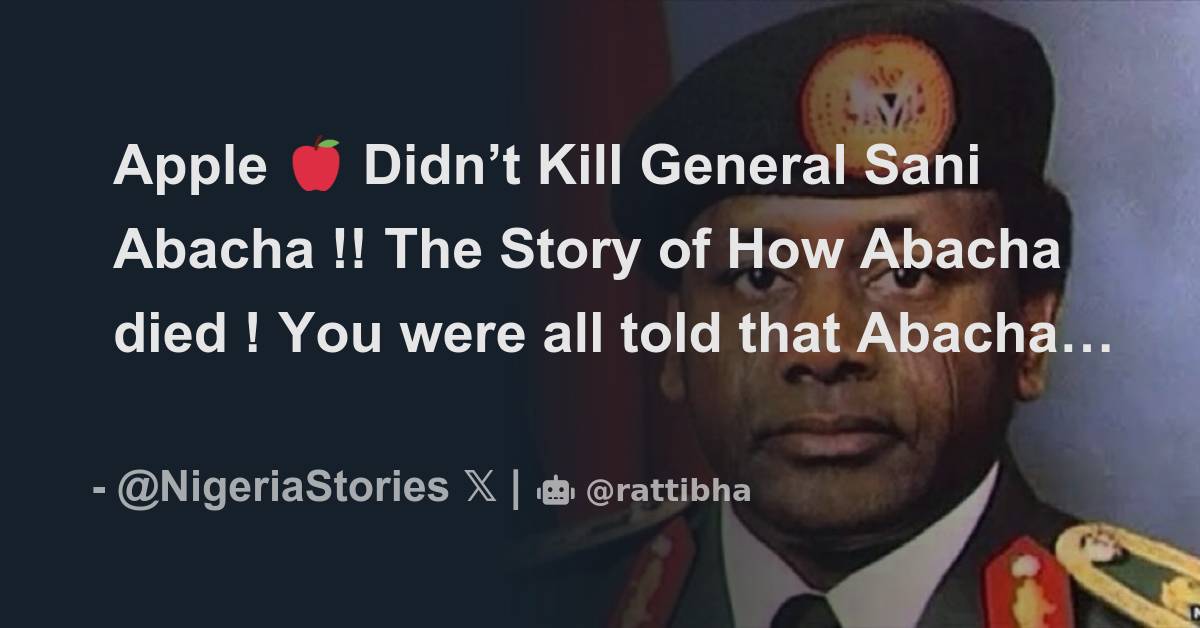

 Didn’t Kill Sani Abacha!”
 The question is:
 Share your opinion in the comments.
 Share this post so people can hear the side of the story that is rarely told.
APPLE Didn’t Kill Sani Abacha!”
…And Who Really Killed MKO Abiola?
An Investigative Inquiry Into Fact, Fiction, & Conspiracy**
Nigeria’s Two Twin Tragedies: A Brief Timeline
In 1998, two of Nigeria’s most consequential political figures — General Sani Abacha and Chief Moshood Kashimawo Olawale (MKO) Abiola — died within one month of each other, creating a vacuum of power and a wellspring of speculation that persists to this day.
Sani Abacha: Official Account
General Sani Abacha, Nigeria’s military ruler from 1993 to 1998, died on 8 June 1998 at the Aso Rock Presidential Villa in Abuja. Government sources and official statements reported a sudden heart attack as the cause of death. No autopsy was performed, and he was buried the same day according to Muslim tradition, which prohibits post-mortem examination.
Facts:
-
Abacha was Nigeria’s head of state from 1993 until his death.
-
His regime was notoriously corrupt and violent, with significant human rights abuses documented by Nigerian and international organizations. (Historical record; see transparency reporting)
Unknowns:
-
No official cause beyond “heart attack” was ever publicly established.
-
Absence of an autopsy intensified public doubt.
MKO Abiola: Official Account
Chief MKO Abiola, the presumed winner of Nigeria’s annulled June 12, 1993 presidential election, died on 7 July 1998 — just almost exactly one month after Abacha’s death. He was in detention and due for release under the new military government of General Abdulsalami Abubakar.
An international team of pathologists, including representatives from Nigeria, the UK, Canada and the US, conducted an independent autopsy, determining that Abiola died of heart disease, not poison.
Facts:
-
Abiola died unexpectedly during a meeting with visiting US diplomats.
-
Autopsy results showed heart disease, and no toxic substances were conclusively identified.
The Conspiracy Web: Poisoned Apple, Handshakes & American Tea
The Yasser Arafat Bodyguard Poisoning Theory
This dramatic narrative — popularized in social media and political commentary — claims that a bodyguard of the late Palestinian leader Yasser Arafat poisoned Abacha via a handshake during a meeting in Abuja, leading to his death.
Origins of the Theory:
-
It was propagated publicly by Femi Fani-Kayode, a former Nigerian aviation minister, in tweets and social posts years after 1998. Fani-Kayode claimed the poisoning was orchestrated at the behest of the US Central Intelligence Agency (CIA) and executed by foreign agents.
Assessment:
-
There is no independent evidence that Abacha was poisoned by Arafat’s bodyguard.
-
This narrative remains unverified and widely considered speculative.
The Susan Rice Tea Poisoning Allegation
One of the most enduring conspiracy theories in Nigeria is that Susan Rice — then US Assistant Secretary of State for African Affairs — served a poisoned cup of tea to MKO Abiola shortly before his death. This allegation is almost always featured in online discussions and even in political speeches.
What Really Happened:
-
Rice was part of a US diplomatic delegation visiting Abiola when he died. She recounted the meeting and Abiola’s collapse in her memoir, where she denied any involvement in poisoning. A doctor was called, and Abiola was taken to a hospital where he died of a heart attack according to medical testimony.
Notable Points:
-
The autopsy and independent medical teams found no evidence of poison.
-
Rice’s memoir specifically disputes the rumor that she killed Abiola and explains its persistence as a conspiracy born from suspicion.
Conclusion:
-
The tea story is widely known but remains unsupported by concrete forensic evidence.
-
Rice and other diplomats have publicly denied any malicious intent.
Where Fact Ends & Conspiracy Begins
1. U.S. Government Involvement
-
Fact: U.S. diplomats were present in Nigeria around the time of Abiola’s death and the presence of senior officials lent fuel to rumors.
-
Conspiracy: Claims that the CIA planned and executed assassinations of Abacha and Abiola are unsupported by official documentation or credible disclosures beyond unverified political claims.
2. Autopsies & Medical Evidence
-
Fact: Abiola’s death was investigated by an international medical team, which concluded heart disease.
-
Unknown: No autopsy was conducted for Abacha, although diplomats later speculated about poisoning.
3. Local Political Context
-
Nigeria’s political landscape in the late 1990s was volatile, with intense international pressure for democratic transition, economic isolation due to sanctions, and internal factionalism, which compounded public mistrust of official versions of events.
Unverified Claims Frequently Circulated
Here are some popular conspiracy narratives with no credible evidence:
-
The CIA orchestrated both deaths to reshape Nigerian politics.
-
Yasser Arafat’s bodyguard was an operative delivering poison to Abacha.
-
Susan Rice deliberately poisoned Abiola’s tea.
None of these claims have been validated by forensic evidence, official disclosures, or credible investigative reporting beyond statements made by local political figures or social media amplification.
What We Know With Confidence
✔ Abacha died in June 1998; official cause cited as heart attack.
✔ Abiola died in July 1998; an independent autopsy found heart disease.
✔ There were American diplomats present at Abiola’s death, including Susan Rice and Thomas Pickering.
✔ Conspiracy theories continue to circulate due to lack of transparent evidence and historical mistrust.
Why the Rumors Persist
In societies with longstanding political tension and lack of transparent official disclosures, stories that mix partial facts with speculation — especially when enhanced by powerful names like the CIA — tend to gain traction. The deaths of two major figures within a short interval, combined with missing medical records and autopsies, create fertile ground for alternative narratives.
Final Thought
At its core, this episode reflects a broader truth about Nigerian political history: a legacy of opacity, violence, and mistrust. Without full disclosure of medical records, witness testimony under oath, and transparent investigations, the space between fact and speculation will remain wide — and commentators on every side will continue to fill it with their own interpretations.
History
In the context of Nigerian history, Susan Rice is primarily associated with her role as the U.S. Assistant Secretary of State for African Affairs during the transition from military to civilian rule in the late 1990s.
Her involvement is characterized by two distinct perspectives: her official diplomatic efforts and a deeply controversial incident involving the death of a prominent political figure.
1. Official Diplomatic Policy
During the Clinton administration, Rice was a key figure in shifting U.S. policy toward Nigeria.
-
Condemnation of Military Rule: In 1998, she delivered a “tough speech” at the Brookings Institution, describing General Sani Abacha as “one of the worst abusers of human rights” and stating that the U.S. would not accept a successor from military ranks.
-
Transition Support: Following Abacha’s sudden death in June 1998, Rice worked to pressure the new military leader, General Abdulsalami Abubakar, to release political prisoners and commit to a swift transition to a democratically elected civilian government.
-
Sanctions: She oversaw the maintenance of sanctions against the military junta to provide “moral impetus” for its eventual collapse and the restoration of democracy.
2. The Death of M.K.O. Abiola
Rice is most frequently cited in Nigeria for her presence during the final moments of Chief Moshood Abiola, the presumed winner of the annulled 1993 election.
-
The Meeting: On July 7, 1998, Rice and Under Secretary of State Thomas Pickering met with Abiola, who was still in custody. During this meeting, Abiola reportedly collapsed after being served tea and died shortly thereafter.
-
Controversy and Allegations: While official reports attributed his death to natural causes (heart failure), Rice’s presence at the scene has remained a focal point for critics. Some activists and family members alleged that the U.S. delegation was pressuring Abiola to renounce his mandate in exchange for his freedom, though the U.S. maintained they were there to facilitate his release.
3. Regional Security
Rice also engaged with Nigeria regarding its regional military role. She coordinated with Nigerian leaders on the ECOMOG peacekeeping force in Sierra Leone, balancing the need for Nigeria’s military cooperation in West Africa with the U.S. demand for democratic reform at home.