


Hyena milk has the highest protein and fat content of any terrestrial carnivore.
Lactating females can carry 3–4 kg (6.6–8.8 lb) of milk in their udders. Spotted hyena milk has the highest protein and fat content of any terrestrial carnivore. Cubs will nurse from their mother for 12–16 months, though they can process solid food as early as three months.
As a result of the submissive behavior in males, it was hypothesized that the male hyena erected its penis as a show of submissiveness. During greetings
https://www.youtube.com/watch?v=rAbhQphEBeg&lc=Ugz3ABYDQggUXo4BZWF4AaABAg.96IUma7GKRP9JHgEMkj3uU
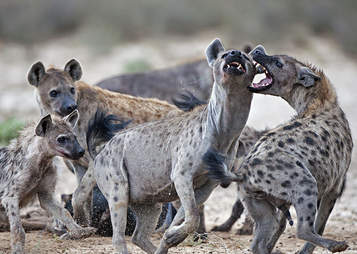
But unlike the lions, whom they laugh at despite their royal status, a male hyena’s life is way worse than a female’s- because they’re basically ostracized once they hit adolescence:
A life of hunting zebras and raising young on the savanna isn’t half bad for a female hyena. Sadly, the same can’t be said for their male counterparts. As MinuteEarth explains, things take a downturn for the males of the species once they hit adolescence. No female in their pack will mate with them, a behavior scientists believe evolved to avoid inbreeding, so they head off in search of a different group to join. After dealing with vicious hazing from their new clan, they file in at the bottom of the rank and wait for other males above them to die so that they can slowly gain status.
Even after rising through the hierarchy, the most a male hyena can aspire to is being second place to the lowest-ranking female. Thanks to their bulky build and aggressive behavior, female hyenas enjoy a dominant position that’s rare in the animal kingdom.
Looks like life got the last laugh Mr. Hyena
WIKI
The spotted hyena is the largest known member of the Hyaenidae, and is further physically distinguished from other species by its vaguely bear-like build,[6] its rounded ears,[7] its less prominent mane, its spotted pelt,[8] its more dual purposed dentition,[9] its fewer nipples[10] and the presence of a pseudo-penis in the female. It is the only mammalian species to lack an external vaginal opening, having a pseudo-penis instead.[11]
The spotted hyena is the most social of the Carnivora in that it has the largest group sizes and most complex social behaviours.[12] Its social organisation is unlike that of any other carnivore, bearing closer resemblance to that of cercopithecine primates (baboons and macaques) with respect to group-size, hierarchical structure, and frequency of social interaction among both kin and unrelated group-mates.[13] However, the social system of the spotted hyena is openly competitive rather than cooperative, with access to kills, mating opportunities and the time of dispersal for males depending on the ability to dominate other clan-members. Females provide only for their own cubs rather than assist each other, and males display no paternal care. Spotted hyena society is matriarchal; females are larger than males, and dominate them.[14]
The spotted hyena is a highly successful animal, being the most common large carnivore in Africa. Its success is due in part to its adaptability and opportunism; it is primarily a hunter but may also scavenge, with the capacity to eat and digest skin, bone and other animal waste. In functional terms, the spotted hyena makes the most efficient use of animal matter of all African carnivores.[15]
The spotted hyena displays greater plasticity in its hunting and foraging behaviour than other African carnivores;[16] it hunts alone, in small parties of 2–5 individuals or in large groups. During a hunt, spotted hyenas often run through ungulate herds in order to select an individual to attack. Once selected, their prey is chased over a long distance, often several kilometres, at speeds of up to 60 km/h